
Motorway service stations are places most of us pass through without much thought. They are designed for brief pauses in everyday journeys – somewhere to stop, stretch your legs, and continue on your way. On the evening of 4 February 1974, one such ordinary place became the setting for a tragedy that would shock the nation and leave a lasting legacy of loss.
That night, a coach travelling along the M62 stopped at Hartshead Moor Services. On board were off duty British soldiers and members of their families, travelling on a route to and from Catterick. They were moving in civilian circumstances, many simply making their way between home and barracks. Some had young children with them. It should have been an uneventful pause in an ordinary journey.
Instead, a bomb hidden inside the coach was detonated.
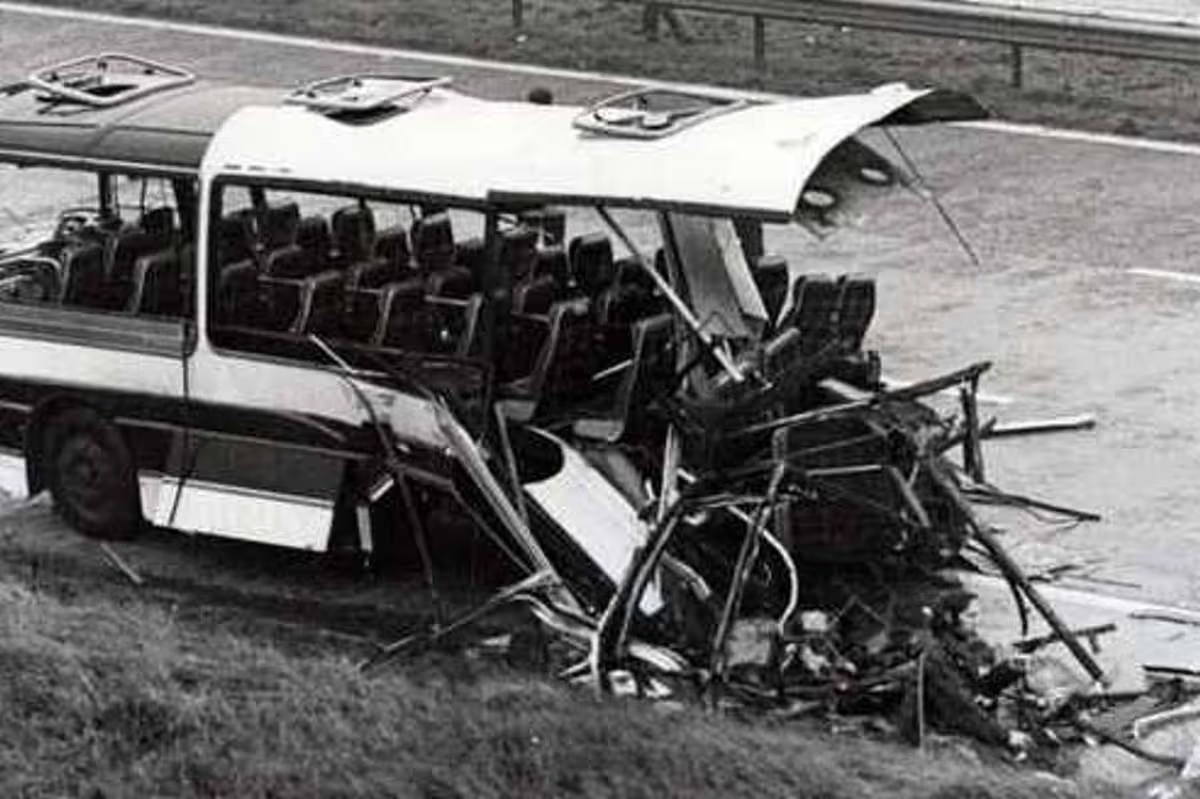
Twelve people were killed in the explosion. Nine were soldiers, and three were civilians, including two children. Many others were injured, and countless families were left dealing with sudden, unimaginable loss. The bombing took place during the Troubles, at a time when violence connected to the conflict in Northern Ireland increasingly reached the British mainland. However, the attack at Hartshead Moor stood out for its brutality and its setting – a public service area used daily by ordinary motorists.
The method of the attack, in which a device was placed on the coach and the perpetrator walked away, led to immediate concern that other coaches could also be at risk. That fear spread quickly across the country.
One of our own branch members, Malcolm, was travelling on a separate military coach the very same evening. His journey was entirely unconnected to the attack, yet the events of that night remain vividly etched in his memory.
Malcolm recalls how his coach, travelling from Leeds towards Hampshire, was stopped by police and escorted to a police station in Northampton. There, all passengers and luggage were removed and searched as a precaution. At the time, those onboard had little information, only a growing sense that something serious had happened elsewhere.
Reflecting on that night, Malcolm speaks not only of the disruption and uncertainty, but of the human cost. The knowledge that families were travelling with children, and that some of those children never had the chance to grow up, has stayed with him ever since. It is a reminder that the effects of that single act of violence were felt far beyond the immediate scene, touching many lives in ways both visible and unseen.
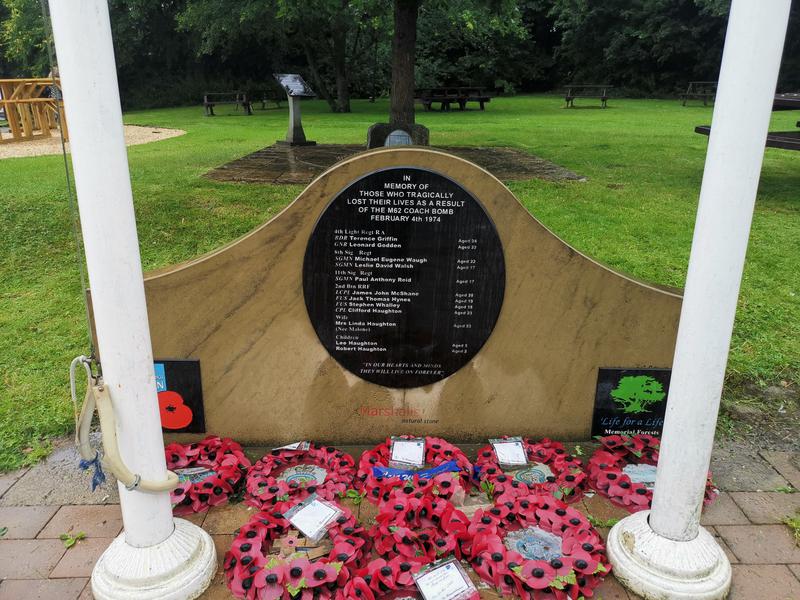
In the aftermath, the Hartshead Moor bombing became one of the deadliest attacks involving British soldiers on the mainland during that period. It drew national attention and caused widespread shock. Yet as the years passed, the event gradually slipped from wider public memory. Today, many people who stop at Hartshead Moor Services are unaware of what happened there, or of the lives that were lost that night.
The memorial garden at the westbound services exists to ensure those individuals are not forgotten. It is a quiet, reflective space set within a location that remains busy and transient. That contrast carries its own meaning. It reminds us that remembrance is not confined to distant battlefields or formal ceremonies, but also belongs in the everyday places where lives were once lost.
Each year, a commemoration is held at the memorial to honour those killed in the bombing. This year’s service will take place on Sunday 8 February 2026 at 11am, in the memorial garden at Hartshead Moor Services (westbound). The ceremony will include an act of remembrance, the Last Post, and the laying of wreaths. Branch secretary and standard bearer Liz Phizackerley-Sugden will carry the Royal British Legion Pudsey and Farsley Branch standard, and our branch will lay a wreath in memory of those who lost their lives.
Including personal memories such as Malcolm’s helps us understand why remembrance remains so important. It reminds us that behind every incident are real people, families, and experiences that continue to resonate decades later. For the Royal British Legion, remembrance is inseparable from support – ensuring that those affected by service and conflict, and their families, are not forgotten.
By coming together to remember the victims of the Hartshead Moor bombing, we reaffirm that their lives mattered, and that their story deserves to be carried forward with dignity and respect.
All are welcome to attend and pay their respects.