On Saturday 31 October 2026 at 2.30pm, Pudsey & Farsley Royal British Legion will commemorate the 70th anniversary of the beginning of British and French military operations during the Suez Crisis.
Suez is a name many people will recognise, but seven decades later the events behind it are perhaps less widely understood. Why was the Suez Canal so important? Why did Britain go to war with Egypt? What happened when British servicemen were sent into action, and why did the operation come to such an abrupt end?
Seventy years on, we look back at the events of 1956 and remember those who served.
Why was the Suez Canal so important?
The Suez Canal runs through Egypt, connecting the Mediterranean Sea with the Red Sea.
Opened in 1869, it transformed international shipping. Instead of travelling around the southern tip of Africa, ships moving between Europe and Asia could take a considerably shorter route through the canal.
By the 1950s it was particularly important to Britain and Western Europe. Large quantities of Middle Eastern oil passed through the canal, while Britain continued to regard it as an important strategic route connecting Europe with Asia and its remaining interests overseas.
Britain had also maintained a considerable military presence in Egypt and the Canal Zone for decades, although growing Egyptian nationalism and opposition to foreign troops had made that presence increasingly difficult to sustain.
Against that already complicated background emerged one of the most influential figures in the modern history of the Middle East.
Nasser and the nationalisation of the canal
Gamal Abdel Nasser became President of Egypt in 1956 and was a powerful advocate of Egyptian and Arab nationalism.
One of his ambitions was the construction of the enormous Aswan High Dam across the River Nile, intended to generate electricity, control flooding and support Egypt’s development.
When the United States withdrew financial support for the project, Nasser responded dramatically.
On 26 July 1956, he announced that the Suez Canal Company would be nationalised. Control of the company and the revenue generated by the canal would pass to Egypt, with the income helping to finance the Aswan Dam.
For Egyptians, the decision represented control over an enormously important asset on Egyptian territory and a reduction in Western influence.
For Britain and France, it was viewed very differently.
The canal was strategically and economically important to both nations, and the decision was regarded as a direct challenge to their influence in the region.
Attempts were initially made to resolve the dispute diplomatically, but behind the scenes something very different was being planned.
A secret agreement
In October 1956, representatives of Britain, France and Israel reached a secret agreement.
The plan was extraordinary.
Israel would invade Egypt and advance towards the Suez Canal. Britain and France would then issue an ultimatum ordering both Egypt and Israel to withdraw their forces from the area around the canal.
Egypt was expected to refuse.
Britain and France would then intervene militarily, officially to separate the two sides and protect the canal. In doing so, they would be able to occupy the Canal Zone and remove Nasser’s control over it.
The United States, Britain’s most powerful ally, was not informed of the plan.
On 29 October 1956, Israeli forces invaded Egypt’s Sinai Peninsula.
Britain and France issued their ultimatum the following day.
Egypt rejected it.
The stage was set for British and French forces to enter the conflict.
Britain goes to war
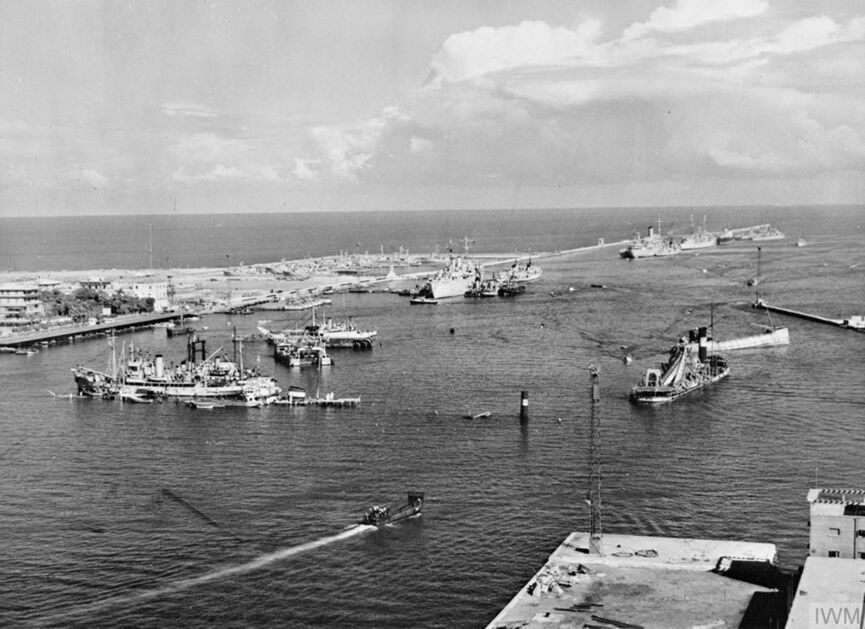
On 31 October 1956, British and French military operations against Egypt began.
This is why 31 October forms the focus of our commemoration 70 years later.
The operation, known as Operation Musketeer, initially involved extensive air attacks against Egyptian military targets, particularly airfields. The intention was to establish control of the skies before troops were committed on the ground.
British forces included the Royal Navy, Royal Air Force, Army and Royal Marines.
On 5 November, men of the 3rd Battalion, The Parachute Regiment were dropped at El Gamil airfield near Port Said.
The following day British and French forces launched amphibious landings, with troops, tanks and Royal Marines coming ashore around Port Said.
Helicopters were also used to carry troops from ships directly into the battle, an early demonstration of a method of amphibious warfare which would become increasingly important in later conflicts.
On the battlefield, British and French forces were making progress.
Away from it, however, the operation was rapidly becoming a political crisis.
Why did Britain stop?
The reaction internationally was enormous.
The United States had not authorised or supported the invasion. President Dwight D. Eisenhower’s administration was furious that Britain, France and Israel had acted without American agreement.
The Soviet Union also strongly condemned the invasion, while pressure grew through the United Nations for the fighting to stop.
Britain was particularly vulnerable economically.
Sterling came under severe pressure on international financial markets and Britain required American support to protect its financial position. Contemporary government records show just how serious concerns about Britain’s gold and dollar reserves had become following the intervention.
The political and economic pressure proved impossible to ignore.
On 6 November 1956, Britain and France agreed to a ceasefire.
The decision came while their forces were still advancing.
British and French troops subsequently withdrew from Egypt, completing their withdrawal by December 1956. Israel later withdrew its forces and the Suez Canal remained under Egyptian control.
A military operation which had lasted only days would have consequences lasting for decades.
What did Suez change?
The Suez Crisis became one of the defining moments of Britain’s post-war history.
Britain still possessed substantial armed forces and had demonstrated that it remained capable of mounting a major overseas military operation.
What Suez exposed was the changing balance of international power.
Britain and France had attempted to act independently in pursuit of their interests, but the enormous pressure exerted by the United States demonstrated the limits of Britain’s ability to operate without American support.
The crisis badly damaged Britain’s international standing and was a personal political disaster for Prime Minister Sir Anthony Eden. He resigned in January 1957.
For historians, Suez has consequently come to represent far more than a dispute over a canal. It marked a significant moment in Britain’s changing role in the world following the Second World War. The National Archives describes it as one of the pivotal episodes in Britain’s post-war history.
But behind the decisions made by governments were the people ordered to carry them out.
Remembering those who served
Sailors served aboard ships in the Mediterranean. Aircrew flew combat operations over Egypt. Paratroopers jumped into action at El Gamil. Soldiers and Royal Marines fought around Port Said.
Among them were National Servicemen, young men who had been called up for military service and suddenly found themselves involved in an international conflict thousands of miles from home.
Whatever the political arguments surrounding Suez, those serving in Britain’s Armed Forces did what generations of servicemen and women have done before and since. They served when called upon to do so.
On Saturday 31 October 2026 at 2.30pm, our branch will come together to commemorate the 70th anniversary of British military operations beginning during the Suez Crisis and to remember all those who served.
For Pudsey & Farsley branch, that remembrance also has a personal connection. Our branch member Steve’s father, Derrick, was a Pudsey resident who served and was involved in Suez. In later years, after retirement, he loved nothing more than enjoying a pint in The Regent.
Seventy years on, we remember Derrick and all those who served.
Lest we forget.